Monitoring intraspecific diversity of dung beetles with DNA metabarcoding
We used metabarcoding not only to identify dung beetle species, but the genetic variability within them.
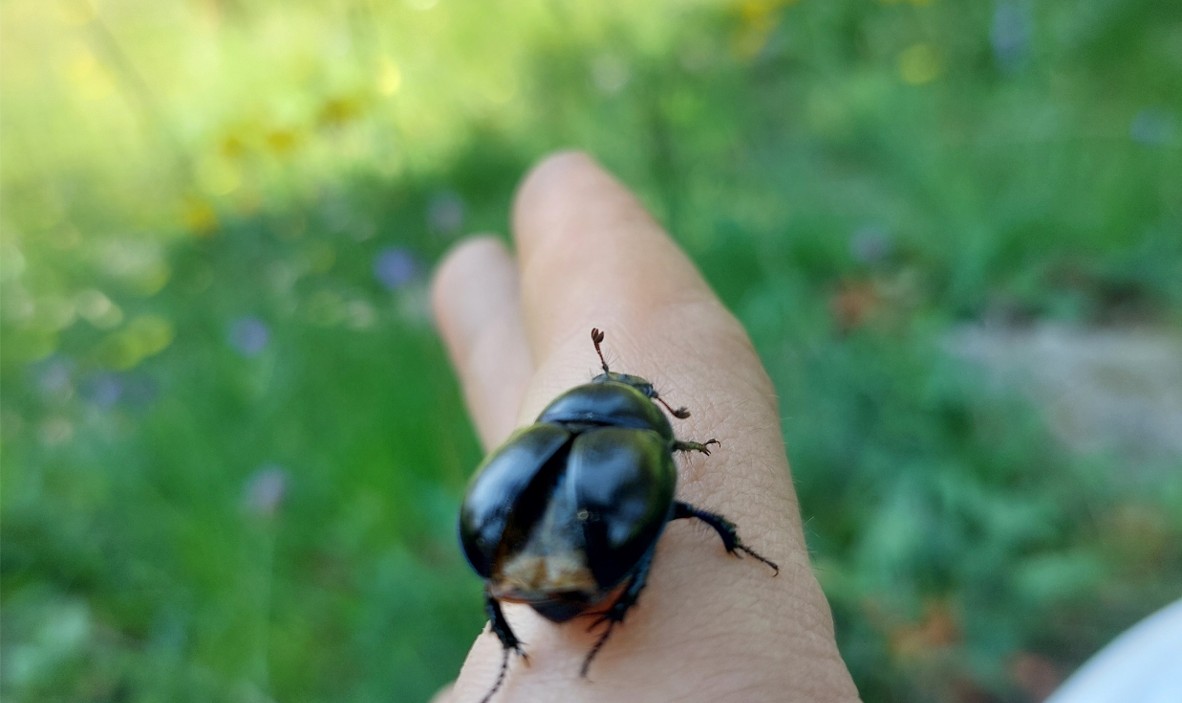
Dung beetle collected during a field transect.
Dung beetles are insects that use dung to feed and reproduce. Widespread across the whole of Italy, they are a particularly charismatic group. The best-known species is probably Sisyphus schaefferi, known for its ability to shape balls of dung and roll them backwards with its hind legs. These insects play a fundamental role in pasture environments, removing much of the animal dung while promoting valuable ecosystem services such as soil fertilisation and the control of harmful organisms.
Beyond their ecological value, dung beetles are ideal model organisms for exploring the potential of DNA metabarcoding to investigate patterns of intraspecific diversity. First, they are easily identified at species level using traditional morphological methods, a trait that makes them perfect for validating molecular results. Second, they show a heterogeneous geographic distribution, linked both to environmental preferences (some species favour cold climates, others warmer environments) and to differing flight abilities (from strong fliers to species with very limited movement).
As part of META2, a PRIN project funded by the Italian Ministry of University and Research (MUR), we collected individuals from geographic areas 50 to 100 km apart to detect any signals of genetic isolation through DNA metabarcoding. The results are very interesting: some species show clear isolation, sharing very few genetic variants between distant areas; other species, in contrast, show variants that are widespread and homogeneous across all the areas studied.
This study shows how metabarcoding has the potential to transform the way we do conservation, offering a precise measure of connectivity between populations.
The practical value of this lies in answering a fundamental question: can a population that has gone locally extinct due to human activity recolonise the area through the dispersal of individuals from geographically separate populations? You can find out more here: www.metasquared.unito.it.