Resilience of freshwater macroinvertebrates to summer droughts
We studied how benthic macroinvertebrate communities resist and recover from increasingly frequent drying events in alpine rivers.
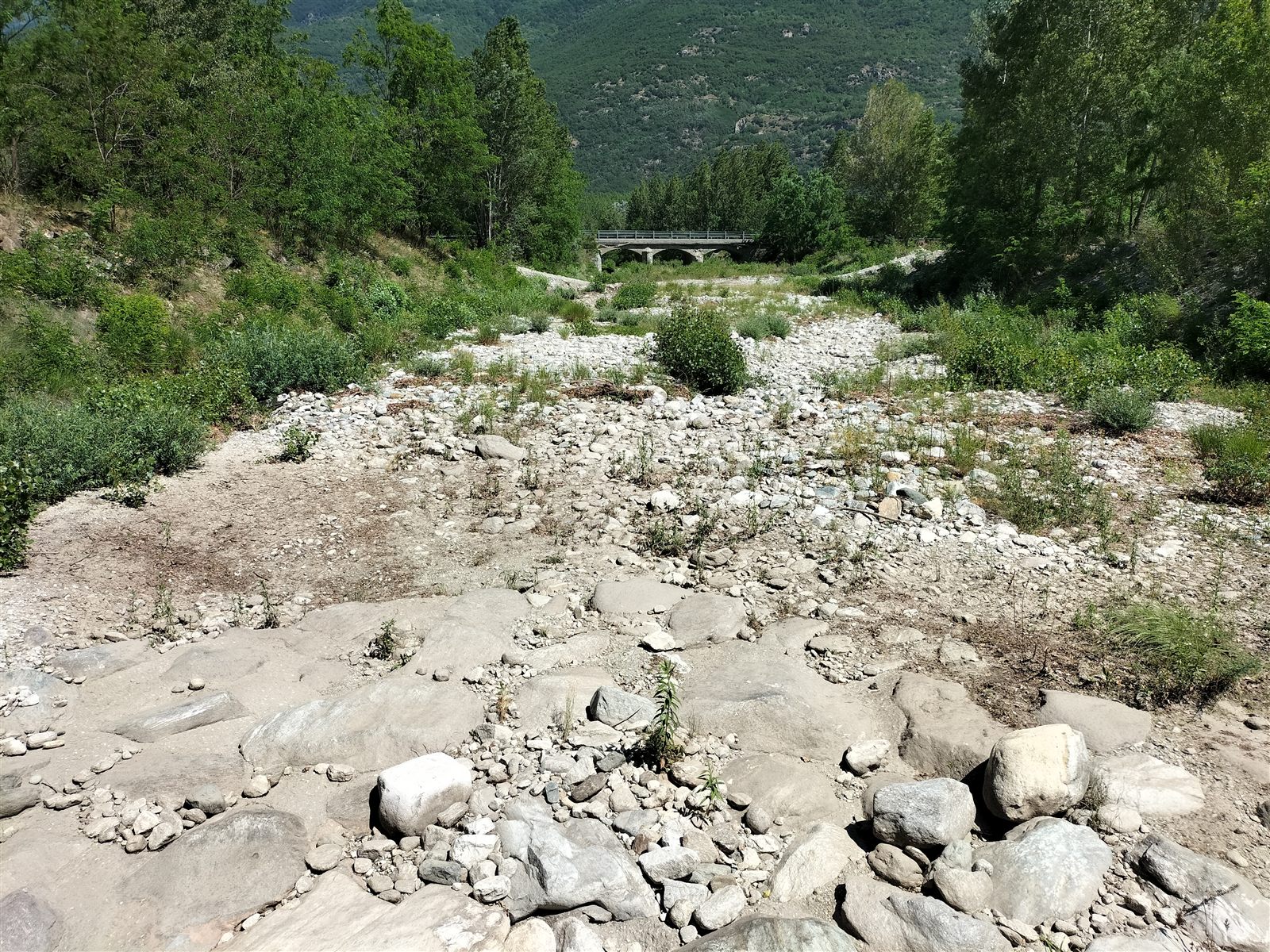
Streambed completely dry during the summer drought.
Hydrological intermittency is the absence of surface flow in rivers and streams, whose most extreme manifestation is the complete drying of the riverbed. This is partly a natural phenomenon: several Italian watercourses, such as the fiumare of southern Italy, have always experienced more or less prolonged dry periods, especially in summer. In recent decades, however, climate change and increasing water withdrawals for agricultural and hydroelectric use have extended the problem to rivers in northern Italy that were historically perennial. An emblematic example is the Po, whose initial stretch now dries up for around 8 km.
This dramatic drying puts severe pressure on aquatic life. Among the organisms most affected are macroinvertebrates, invertebrates visible to the naked eye (larger than 1 mm) such as insects, crustaceans, molluscs and worms. Their presence is crucial to ecosystem health, so much so that they were the first organisms included in Italian legislation for assessing water quality (Legislative Decree no. 152 of 1999). Hydrological intermittency wipes out the macroinvertebrate community entirely, and it only repopulates the dried-out reaches once the water returns. This phenomenon, known as resilience, depends on many factors, and studying it would help define optimal conservation strategies for river management.
Because species-level identification is difficult, macroinvertebrates are usually identified to genus or, more often, family level. For biomonitoring purposes this is not a problem, since macroinvertebrate species generally respond to environmental stress in a uniform way within genera or families.
To track the recolonisation of intermittent rivers, however, organisms must be identified at species level. Each species can in fact respond differently to hydrological intermittency.
Our research group, in collaboration with the Po River District Authority, the University of Parma and the Politecnico di Torino, carried out species-level identification of macroinvertebrates using DNA metabarcoding. The results are very clear and show that, within the same genus or family, species can respond differently to intermittency.